
Jellyfish iceberg
Jellyfish iceberg is an iceberg chart topic. On r/IcebergCharts, the highest-scoring available chart on it, "The Jellyfish Iceberg (IcebergThreads version)", was posted by u/Feelcy9908_2 on 31 January 2026 and had about 44 upvotes when it was collected.[1] The subreddit has 1 other chart on the same or closely related topics; see Other versions. A text version, "The Jellyfish Iceberg" by Lidenskab, is hosted on IcebergThreads, where it had 876 views as of 29 October 2026.[2]
The IcebergThreads author describes it as: "This iceberg chart is mainly focused on jellyfish, though it may occasionally include entries about Hydra, siphonophores, or other similar creatures."
Entries reflect the chart authors' choices and are not verified fact.

Tiers[edit]
Tiers and entries from the IcebergThreads version[2]. Notes after a dash are shortened from the author's explanations.
Tier 1[edit]
- Cnidaria – The majority of jellyfish are found in the phylum Cnidaria, along with coral, hydroids and sea anenomes.
- Moon Jelly (Aurelia Aurita) – One of the most abundant species of jellyfish, found around most parts of the world other than Arctic and Antarctic waters. It has a weak sting.
- Brainless – Jellyfish lack a brain, heart, and bones. While jellyfish don't have a brain, they can sense light and have coordinated swimming behaviors, which help keep them in good places to hunt for microscopic…
- Box Jellyfish – A well known type of venomous jelly, with some species being lethal to humans.
- Life cycle – The life cycle of a jellyfish
- Lion's Mane Jellyfish – Largest jellyfish, reaching 36m in length.
- Comb jellyfish – A unique species of jellyfish
- Bioluminescence – Some jellyfish use bioluminescence
- Nematocysts – The things in stingers that make them sting
- Jellyfish Blooms – Large growths in jellyfish populations
- Manubrium – Mouth of a jellyfish
- Oxygen Diffusion – Oxygen from the water diffuses through the jellyfish's skin
- Smallest jelly ever – The creeping jelly is around 0.5 mm
- Reproduction – Jellyfish can reproduce both asexually and sexually
- Origins of Some Terms – The free swimming form of many jellyfish is referred to as a Medusa, from the character of Greek Mythology. Similarly, the genus Chrysaora is named after her offspring, Chrysaor.
- Siphonophores Lack a Central Brain – Yeah.
- Mesoglea – In the body wall, very elastic, controls buoyancy along with other factors.
- Jellyfish are Plankton – zooplankton
Tier 2[edit]
- Dead jellyfish can still sting – Pretty self explanatory, be careful!
- Immortal Jellyfish – It is biologically immortal, returning to larvae stage when stressed
- irukanji syndrome – A condition from being stung by an irukandji jellyfish
- The most dangerous animal in the world – Box jellyfish kill more people than any other animal
- Jellyfish have been around for 550 million years. – Even though, they have evolved.
- Jellyfish lake – A marine lake that has jellyfish in it.
- Oh Boy Jellyfish! – a box jelly species named during a competition, when a marine biologist said "Oh boy!"
- Ocelli – Eye-like things some jellyfish have that can sense light and movement
- Catostylidae – A family of jellies, known as the fat-armed jellyfish because of their large oral arms
- Essexella – An extinct cnidarian, that was first described as a jellyfish, before later being redescribed as a sea anenome.
- bluefire jellyfish – A species of jellyfish that is found off the coast of Ireland, and well known for its dazzling blue colour.
- Chrysaora achlyos – The black sea nettle, a species of jellyfish that can grow over 6 meters in length.
- 47m Siphonophore – Apolemia, a species of siphonophore reaching 47 meters in length.
- Beroe ovata – A species of ctenophore that swallows its food and zips its mouth shut. Scientists have tried to open its mouth, but the flesh around it rips before the mouth itself is unzipped.
- Polypodium hydriforme – A species of parasitic cnidarian that parasitizes many fish eggs, such as the caviar we eat.
Tier 3[edit]
- Cannonball Jellyfish – This species lacks stinging tentacles, instead, it enzymatically dissolves its prey.
- Jellyfish-fish symbiosis – A case of commensalism involving fish and jellyfish.
- Cloning – Some species have the ability to clone themselves if cut in half.
- Upside Down Jellies – A species that rest on the sediment of a body of water.
- Common Kingslayer – [Lidenskab] this species has the coolest name of any animal I've ever seen. It sounds like the species slays kings regularly XD
- Porpita porpita – The blue button, is actually a colony of hydroids.
- Chirodectes – Extremely rare box jellyfish, only seen twice
- Invasive Jellyfish clones – self explanatory
- Benthic Jellyfish – jellyfish that live on the sea floor
- Stauromedusae – "Stalked jellyfish", are benthic for their whole life cycle
- Clytia hemisphaerica – A very small species of cnidarian, (hydrozoan-group) and grows to 1 cm.
- Rhopilema esculentum – A popular jellyfish for cuisines. Other than that, it is native to Japan.
- Planula – Free swimming larval form of some cnidarians.
- Chrysaora hysoscella – The compass Jellyfish, lives in cold or temperate waters.
- Jellyfish Act of 1966 – The United States's act of elimination of pests such as jellyfish in coastal areas.
- Haootia Quadriformis – A cnidarian from 560 million years ago, the earliest evidence of muscle tissue.
Tier 4[edit]
- Pink Meanie – A species of jellyfish that eats other jellies.
- Myxozoans – Cnidarian endoparasites that infect fish and other organisms.
- Auroralumina – Earliest ever known animal predator
- Jellyfish clogging power plants – Jellyfish can get into cooling water intake systems, disrupting use at power plants.
- Tentacle regeneration – some species can regenerate tentacles
- Jellyfish learn from their mistakes – Caribbean box jellyfish, for example, have one thousand nerve cells, and can learn from past experiences to dodge obstacles.
- Petrozavodsk Phenomenon – A UFO that resembles a jellyfish according to many
- Phyllorhiza punctata – HHAHAHAHA! Australian Spotted Jellyfish, I often see them when I go down to a river near my house, along with moon jellies. They are legit awesome - stxr
- Cyanea annaskala – (Lidenskab) okay now this has become one of my favorite Cnidaria, it looks so cool i can't believe its actually real XD !!
- Bathyphyla Conifera – A species of siphonophore commonly called the 'Flying Spaghetti Monster'
- Angler Siphonophore – It lures fish with its bioluminescent lure.
- Emperor Hirohito – A Japanese Emperor who discovered and described multiple jellyfish species.
- The Boat That Destroyed an Ocean (almost) – In 1982, a ship leaving from the US to the Black Sea accidentally introduced ctenophores into it. In the following years, fisheries based in the Black Sea began to plummet, unable to fish with so…
- Venus Girdle – Largest known ctenophore, also very thin. (imo its pretty cool - stxr)
Tier 5[edit]
- Red Cross Jellyfish – Jellyfish with a red cross on it.
- Poralia – A little-known deep sea jelly
- Lampocteis – bloodybelly comb jelly
- Bathocyroe fosteri – A bioluminescent ctenophore.
- Crambione Cooki – rare jellyfish species, presumed extinct until sighted in 2013.
- Erumia – Erumía is a gigantic jellyfish associated with the Papuan village of Mawata. Mythological Being
- Biohybrid Jellyfish – Jellyfish with robotic parts (kind of)
- Crabs ride jellyfish – self explanatory
- Mucus Bombs – They release venom-filled blobs of mucus into water where it stings passing swimmers
- Velella velella – A species of siphonophore, that flow with the wind using their sail. (This thing actually looks so funky :P - stxr)
- Atolla jellyfish – (Lidenskab) When attacked, it (Atolla jellyfish) will launch a series of flashes, whose function is to draw predators who will be more interested in the attacker than itself.
- Mawia benovici – Species of jellyfish. (This one looks satisfying - stxr)
- Pelagia noctiluca – PURPLE PEOPLE EATER JELLYFISH. It has a nasty sting
- Deepstaria enigmatica – A deep-sea jellyfish that lacks tentacles, causing it to resemble a plastic bag. It is usually found around Antarctic waters.
- Tiburnia granrojo – A strange deep sea jellyfish that has tentacles covered in warty-nematocysts.
Tier 6[edit]
- 24 Eyed Jellyfish – A species of box jellyfish that had adapted to have eyes - 24 of them.
- Jellyfish in Outer Space – Jellyfish were sent into outer-space by NASA in 1991
- Age in Reverse – Comb Jellies can age in reverse, back to a polyp.
- Atmospheric Jellyfish – Cryptid jellyfish-esque creatures that float in the air
- Kuranda Jellyfish – In 1973, a ship named Kuranda collided with a jellyfish in the South Pacific while traveling through a storm on her way to the Fiji Islands. Turned out to be a lion's mane jellyfish
- Hitchhikers – Some larval species actually settle down on a jellyfish's bell for some of their life
- The Appalachian Mountain Jellyfish – Craspedacusta sowerbyi, rare species of freshwater jelly.
- Mass Velella beaching – Thousands or Millions of velella velella being beached in 2006
- Haliclystus sanjuanensis – Small species of stalked jellyfish,
- zooxanthellae symbiosis – Mastigias jellyfish have a symbiotic relationship with zooxanthellae
- Giant Phantom Jelly – An extremely rare jellyfish, that grows up to 10m in length. It is found in the midnight and twilight zone, at depths of around 6,600m.
- Fish using jellyfish for protection – A fish built up immunity to stinging cells of a jellyfish, and used it for protection against predators.
- Sea Slug Techniques – The Opalescent Sea Slug has worked out a way to eat Polyorchis penicillatus. The sea slug glides onto sea grass, or other access points, and when the jellyfish swims upwards, it may get stuck in this…
- Drymonema gorgo – A rare species of jellyfish found in the south atlantic.
Tier 7[edit]
- Gelatinous Cube of London Bridge – A jellyfish-esque cryptid sighted under the London Bridge.
- Fusion – Two comb jellies have been sighted fusing together to become one jellyfish.
- Bermuda Jellyfish – 'In 1969, divers Richard Winer and Pat Boatwright saw a jellyfish 50-100 feet in diameter that was slowly swimming up towards them, but eventually gave up. They said it was deep purple with a pink…
- five-lined constellation fish – A hypothetical fish sighted by William Beebe. It is assumed that it could've been a comb jelly.
- Jellyfish sunk a 10 ton boat – Nomura jellyfish, that can weigh over 200kg each, were enough to sink a 10 ton boat,
- Flying Jellyfish Cryptid – A person in the US supposedly saw a jellyfish fly through the air, above their hometown
- hydranths – A polyp in a hydrozoan colony that is specialised for feeding
- Medusafish – Fish that have a communalistic relationship with jellyfish, scavenging their meals and using them as protection.
- Paper nautilus egg protection – A paper nautilus can use jellyfish to protect their eggs from predators
- Undescribed species of Narcomedusae – A species of Narcomedusae, only seen once before, sighted by the Nautilus team. It was identified as being an undescribed species in the order Narcomedusae
- Cyro – A giant robotic jellyfish built for the U.S. Navy for "gathering intelligence".
Tier 8[edit]
- Shark-eating Jellyfish – A cryptid, accounted by Eric Russel in his book Great World Mysteries. A 1953 Australian diver was being tailed by a fifteen-foot shark, as he swam down to the ledge of a deep chasm. It is said that…
- Missing Diver – The Sunday Times, August 7th 1 93 8- Japanese diver Masao Matsumo descended from the lugger Felton, off Darnley Island, near Darwin, Northern Territory of Australia. He gave the signal to be hauled…
- 1980 Human-eating Jellyfish – This has been dotted around in a couple cryptozoology books, and I believe it originates from the issue #55 of Fortean Times. It is about a French man named Henri Baiselle, who, in 1989, called the…
- Jellyfish Could Cure Memory Loss – Jellyfish protein (apoaequorin) is claimed to improve memory and cognition in humans.
Other versions[edit]
Other charts from r/IcebergCharts grouped under this topic, ordered by score:
-
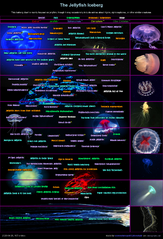 The Jellyfish Iceberg by u/Feelcy9908_2, 26 April 2025 (1 upvote)

See also[edit]
Sources[edit]
- Featured Reddit chart: u/Feelcy9908_2. The Jellyfish Iceberg (IcebergThreads version). Reddit (r/IcebergCharts). 31 January 2026. Retrieved 29 October 2026.
- IcebergThreads version: Lidenskab. The Jellyfish Iceberg. IcebergThreads. 21 January 2026. Retrieved 29 October 2026.
References[edit]
- ↑ u/Feelcy9908_2. The Jellyfish Iceberg (IcebergThreads version). Reddit (r/IcebergCharts). 31 January 2026. Retrieved 29 October 2026.
- ↑ 2.0 2.1 Lidenskab. The Jellyfish Iceberg. IcebergThreads. 21 January 2026. Retrieved 29 October 2026.